
Defining Headless Architecture
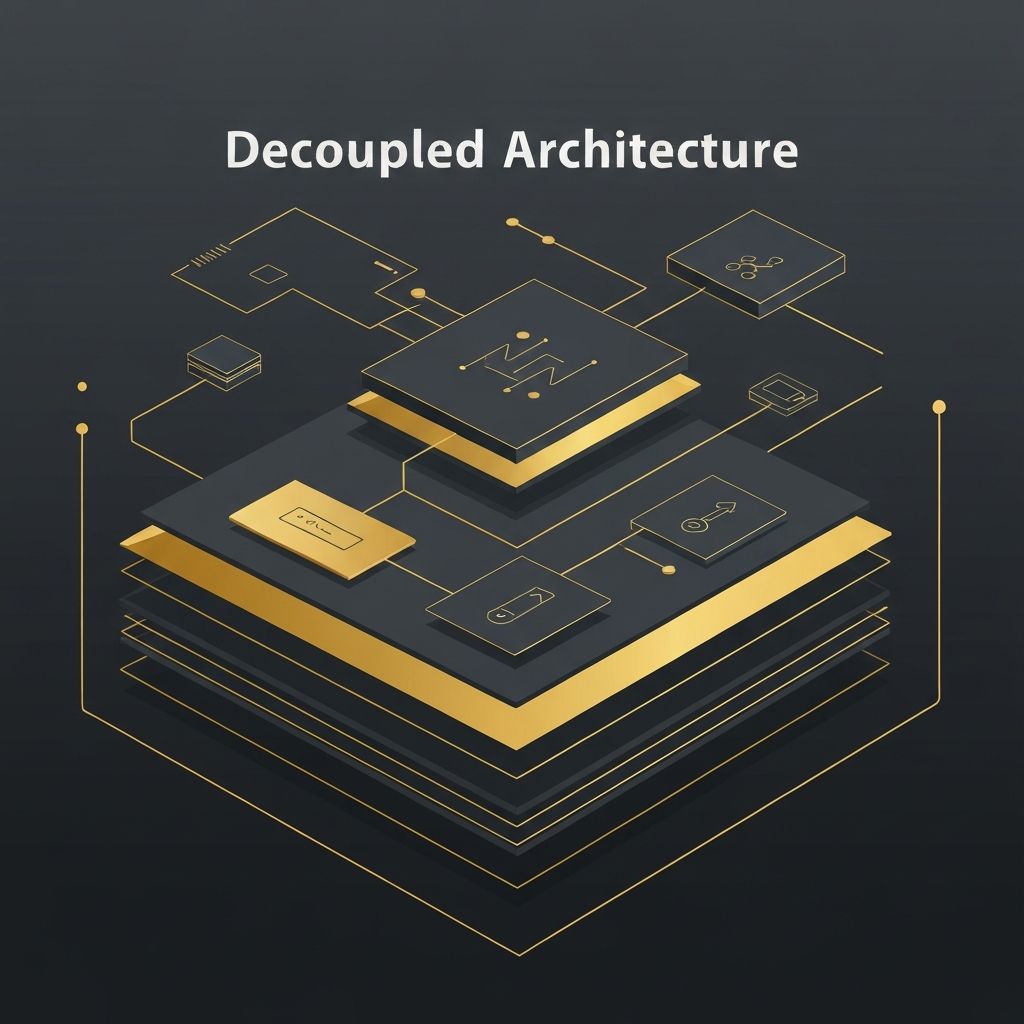
Headless in web development refers to decoupling the content management system from the presentation layer—separating the "head" (what users see) from the "body" (where content is managed and delivered). Traditionally, websites bundled content management and presentation tightly—WordPress manages content and displays it through WordPress templates. Headless architectures separate these concerns. A headless CMS stores and manages content through APIs, while separate frontend applications consume and display that content. This architectural separation enables flexibility, scalability, and modern development practices impossible with traditional monolithic systems.
The term "headless" originated with e-commerce platforms but has expanded to broader web development. It represents a fundamental shift from monolithic platforms serving specific purposes to modular architectures where components serve specific functions. This modularity enables teams to optimize each component independently, use best-of-breed tools, and adapt quickly to changing requirements.
AAMAX.CO's Headless Architecture Expertise
AAMAX.CO specializes in modern web application development incorporating headless architectures where they benefit clients. Their team understands when headless approaches unlock value—complex omnichannel content delivery, rapid frontend iteration, multiple consumer experiences from single content source—and when traditional coupled architectures suffice. This expertise ensures clients adopt appropriate architecture for their needs, avoiding unnecessary complexity while capturing benefits when they're meaningful.
Traditional Monolithic Architecture vs. Headless
Traditional websites combine everything—content management, presentation logic, database, and front-end rendering. WordPress stores content in its database, manages content through its admin interface, and displays content through WordPress templates. This monolithic approach works well for straightforward websites but limits flexibility as requirements grow complex.
Headless architecture decouples these layers. A headless CMS manages content through APIs but doesn't dictate how content is displayed. Frontend applications consume these APIs and implement presentation. This separation enables different frontends consuming the same content—a website, mobile app, voice interface, and other experiences can all draw from the same content source. Frontend teams can use modern frameworks (React, Vue, Svelte) independent of CMS technology. Content managers work in a dedicated interface optimized for content creation. Developers building experiences work with familiar tools.
API-First Content Delivery
Headless CMSs expose content through APIs rather than serving rendered HTML. Frontend applications request content, receive structured data (usually JSON), and render it appropriately. This API-first approach enables programmatic content access. Applications fetch the exact content they need, nothing more. APIs enable querying (get articles published since yesterday), filtering (get articles in the technology category), and pagination (get articles in batches). This programmatic access makes content delivery flexible and efficient.
The API-first approach also enables caching strategies improving performance. Edge networks cache API responses, delivering content faster to distant users. Static site generation fetches content at build time, creating fast static files served from CDNs. Content updates trigger rebuilds or cache invalidation, ensuring users see current content. These optimization techniques are easier with API-first architectures than with traditional server-rendered systems.
Decoupled Frontend and Backend Development
Headless architecture enables frontend and backend teams to work independently. Backend teams managing CMS and APIs focus on content structure, API design, and performance. Frontend teams focus on user experience, design implementation, and optimization for their specific platform. Teams can use different technology stacks optimized for their domain. Backend might use Node.js while frontend uses React. These teams coordinate through APIs but work independently.
This independence accelerates development. Frontend teams aren't blocked waiting for backend changes. They can mock APIs and develop in parallel. Backend teams can refactor without affecting frontends as long as APIs remain stable. This parallel development, coordinated through versioned APIs, enables faster iteration than tightly-coupled systems.
Omnichannel Content Delivery
Many organizations need content across multiple channels—websites, mobile apps, email, social media, voice assistants, wearables. Headless architecture makes omnichannel delivery straightforward. Content creators maintain single content sources. Multiple frontends consume this content, each optimized for its platform. A blog post managed once appears on the website, is shared on social media, appears in the email newsletter, and is available through a mobile app—all from the same content source.
Maintaining consistency across channels without duplicating content becomes essential as channels proliferate. Headless architecture enables consistency with single content governance while allowing channel-specific customization. Each channel can adapt content (mobile might show summarized versions of long articles) while maintaining core consistency.
Flexibility and Future-Proofing
Technology choices become outdated. Frontend frameworks rise and fall—jQuery gave way to React, Vue, Angular. Headless architecture enables upgrading frontend technology without migrating content or backend systems. The organization can adopt new frontend frameworks, platforms, or channels without content system changes. This flexibility protects investments in content and ensures the technology stack doesn't dictate business capabilities.
Similarly, CMS technology can evolve without frontend changes. If the current CMS becomes inadequate, switching to different CMS technology is possible if the API contracts remain stable. This flexibility represents a significant advantage in rapidly evolving technology environments where committing to specific technologies for long periods is risky.
Scalability and Performance
Headless architecture enables optimizing content delivery for performance. APIs serve structured data that clients process efficiently. Static site generation creates cached, fast-loading files. Content is served from CDNs geographically distributed for low latency. Backend content services scale independently from frontends. This separation enables each component to scale according to its specific demands.
A website experiencing viral traffic needs frontend scaling (more web servers, better caching). The content API might handle the load fine. Headless architecture enables scaling what needs scaling without scaling the entire system. This efficiency reduces infrastructure costs and improves performance under varying loads.
Content Modeling and Structure
Headless CMSs emphasize structured content—defining content types with specific fields rather than free-form content. A blog post might have title, author, publication date, featured image, content, and tags. This structure enables programmatic content handling—sorting by date, filtering by tags, checking for required fields. Structure also enables content reuse and transformation.
Structured content enables AI/ML applications better than unstructured content. Recommending related content becomes easier with tagged, categorized content. Searching becomes more sophisticated with field-aware indexing. Multi-language content becomes easier with structured fields. This structure imposes discipline on content creation but pays dividends in content management, delivery, and optimization.
GraphQL and Query Flexibility
GraphQL represents an evolution of API design particularly well-suited to headless architectures. GraphQL enables clients to specify exactly what fields they need, eliminating over-fetching (receiving unnecessary data) and under-fetching (needing to make multiple requests). Complex queries can fetch related data in single requests. Query complexity can be controlled server-side, preventing resource-exhausting queries.
GraphQL APIs are self-documenting and introspectable—tools can discover available queries and fields automatically. This discoverability accelerates frontend development and reduces onboarding time for new developers. The flexibility of GraphQL—where clients request exactly what they need—makes it superior to REST for complex data requirements common in modern applications.
Content Preview and Editing
A challenge with headless CMSs is content preview—editors creating content need to see how it looks. Most headless CMSs now provide preview capabilities showing how content renders in specific frontends. Some enable editors to see content in-context within the actual application design. These previewing capabilities ensure editors understand how content appears without requiring technical knowledge.
Edit capabilities within frontend applications (in-context editing) are becoming more common. Editors can click content and edit it directly within the live site, seeing changes immediately. This real-time, visual editing experience bridges the gap between traditional WYSIWYG editors and headless CMSs, providing both the flexibility of headless architecture and the intuitiveness of traditional systems.
Security and Access Control
Headless architecture enables granular access control. Content APIs can restrict what data different applications or users access. A public website API might expose published content only. An authenticated mobile app might access draft content for preview. Admin applications might have full access. This granular control isn't always possible with monolithic systems where one set of permissions applies broadly.
API-based architecture also isolates content systems from presentation security issues. If a frontend is compromised, content remains protected behind API authentication and authorization. Frontend vulnerabilities don't directly expose content or user data. This isolation improves overall security posture.
Common Headless CMS Platforms
Numerous headless CMS platforms serve different needs. Contentful, Sanity, and Strapi offer cloud-hosted solutions with strong developer experiences. Statamic and Payload offer self-hosted options. Some organizations build custom headless CMSs on traditional platforms like WordPress (using it as headless via REST API). The variety of options enables choosing platforms matching specific needs—budget, features, scalability, support requirements.
Many organizations also adopt hybrid approaches, using traditional CMSs in headless mode—WordPress via REST API, Drupal via APIs. This pragmatic approach captures headless benefits while leveraging existing content and team familiarity.
Use Cases Where Headless Excels
Headless architecture particularly benefits omnichannel applications delivering content across websites, apps, and other channels. Organizations with frequent frontend changes find headless valuable—design changes don't require backend changes. E-commerce platforms commonly use headless to deliver products across multiple storefronts. Organizations needing rapid frontend iteration or wanting to use cutting-edge frontend frameworks find headless enabling.
However, headless isn't universally appropriate. Simple blogs or brochure sites might not need headless complexity. Headless increases architectural complexity and operational overhead. Organizations need sufficient scale and flexibility needs to justify this complexity. Right-sizing the architecture to actual needs ensures investments benefit the business.
Challenges and Considerations
Headless architecture introduces complexity. More systems to maintain, more API integration points, more potential failure modes. Transitioning to headless requires coordinating multiple systems. Organizations need expertise in both content systems and frontend development. Teams must coordinate across boundaries more deliberately than in monolithic systems.
Performance optimization becomes more complex. With multiple frontends and APIs, understanding performance requires coordinating across components. Static generation, caching strategies, and CDN configuration all require careful consideration. However, with proper implementation, headless architecture often performs better than monolithic alternatives.
The Future of Web Architecture
Headless architecture represents the direction web development is moving. As organizations increasingly operate omnichannel, maintain complex technology stacks, and iterate rapidly, headless approaches become increasingly valuable. The trend toward specialized tools optimized for specific purposes aligns with headless principles. Future web development will likely see increasingly sophisticated headless applications, edge computing integration, and continued separation of concerns.
Conclusion: Headless as Architectural Evolution
Headless in web development represents decoupling content management from presentation—a fundamental architectural evolution enabling flexibility, scalability, and modern development practices. Rather than forcing all needs through monolithic platforms, headless enables specialized tools optimized for specific purposes. For organizations with omnichannel requirements, rapid iteration needs, or complex technology ecosystems, headless architectures unlock significant value. While not appropriate for all use cases, headless represents an important architectural pattern for modern web development.
Want to publish a guest post on aamconsultants.org?
Place an order for a guest post or link insertion today.