
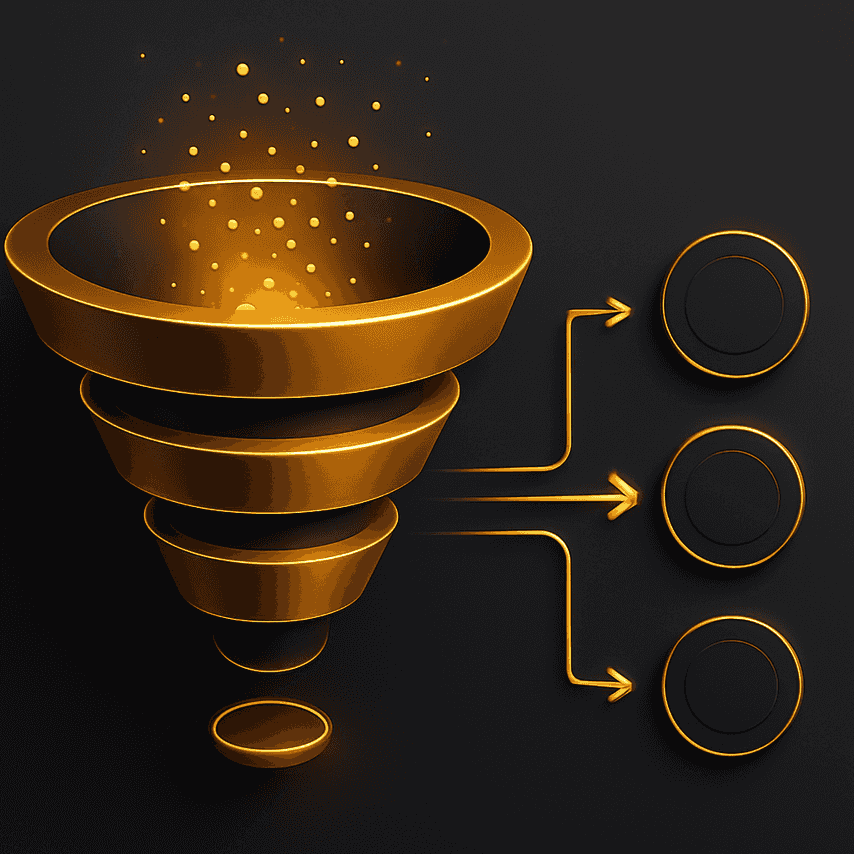
Every customer takes a journey before making a purchase, and in digital marketing, that journey is represented by the sales funnel. Understanding the sales funnel is fundamental to converting strangers into paying customers and, ultimately, loyal advocates. The funnel framework helps marketers visualize where prospects are in their decision-making process and what they need at each stage. By mapping and optimizing this journey, businesses can guide more people toward a purchase while making their marketing more efficient and effective.
What a Sales Funnel Is
A sales funnel is a model that describes the stages a potential customer moves through, from first becoming aware of your brand to making a purchase and beyond. It is called a funnel because it starts wide, with many people becoming aware of your business, and narrows as prospects drop off at each stage, leaving the most qualified buyers at the bottom. The funnel helps marketers understand and influence customer behavior at every step.
How AAMAX.CO Builds High-Converting Funnels
Designing a funnel that actually converts requires strategy, the right tools, and continuous optimization. AAMAX.CO is a full-service digital marketing company offering web development, digital marketing, and SEO services worldwide, and they specialize in building funnels that turn traffic into customers. Their team aligns landing pages, content, and campaigns into a seamless journey, ensuring your digital marketing efforts move prospects efficiently from awareness all the way to purchase and loyalty.
The Awareness Stage
At the top of the funnel, the goal is to attract attention and make people aware of your brand. This is where prospects first discover that you exist, often through a search result, social post, ad, or piece of content. Strategies like search engine optimization help you appear when people search for relevant topics, drawing in a broad audience. The focus here is on reach and education rather than selling.
The Interest and Consideration Stage
Once prospects are aware of you, the middle of the funnel works to build interest and trust. Here, prospects are evaluating their options and learning more about how you can solve their problem. Valuable content, email nurture sequences, and engagement through social media marketing keep your brand top of mind and position you as the best choice. This stage is about nurturing relationships and demonstrating value, not pushing for an immediate sale.
The Decision and Conversion Stage
At the bottom of the funnel, prospects are ready to make a decision. The goal is to convert them into customers by removing any remaining barriers and providing a clear, compelling reason to buy. Targeted offers, strong calls to action, testimonials, and retargeting campaigns such as Google ads help close the sale. A smooth, frictionless checkout or signup experience is critical at this stage, since even small obstacles can cause prospects to abandon their purchase.
The Post-Purchase Stage
The funnel does not end at the sale. Retaining customers and turning them into repeat buyers and advocates is essential for sustainable growth. Excellent onboarding, helpful follow-up content, and ongoing engagement keep customers satisfied and loyal. Happy customers often refer others, effectively feeding new prospects back into the top of your funnel and reducing your overall acquisition costs over time.
Optimizing Your Funnel
A sales funnel is never finished; it requires ongoing optimization. By analyzing where prospects drop off, you can identify weak points and improve them. Testing different headlines, offers, landing pages, and calls to action reveals what resonates with your audience. Tracking conversion rates at each stage shows whether your changes are working. This continuous refinement gradually increases the percentage of prospects who move all the way through the funnel.
Common Funnel Mistakes
Many businesses lose customers by focusing only on the top of the funnel, driving traffic without nurturing or converting it. Others neglect the post-purchase stage, missing opportunities for repeat business and referrals. Inconsistent messaging across stages, unclear calls to action, and friction in the buying process also cost conversions. Avoiding these mistakes requires viewing the funnel as a complete, connected journey rather than a series of disconnected tactics.
Conclusion
A sales funnel in digital marketing maps the journey customers take from awareness to purchase and beyond. By understanding each stage, awareness, interest, decision, and post-purchase, and optimizing the experience at every step, businesses can convert more visitors into customers and turn customers into loyal advocates. A well-designed, continuously optimized funnel is one of the most powerful tools for predictable, sustainable growth in any digital marketing strategy.
Want to publish a guest post on aamconsultants.org?
Place an order for a guest post or link insertion today.