
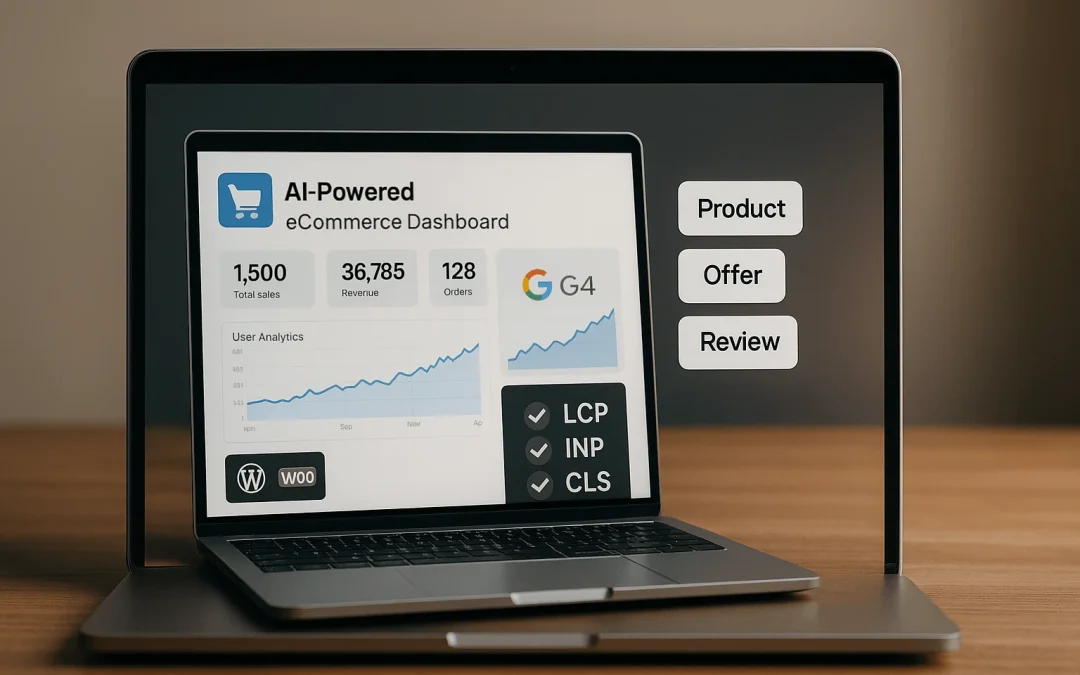
Manual SEO can’t keep pace with fast-moving catalogs and shifting SERP formats. The fix isn’t “more hands”, it’s AI-powered SEO that scales high-quality work across PDPs, collections, and content hubs without losing brand voice. Done right, AI compounds traffic and revenue by making every page clearer, faster, and easier to discover.
Why AI for eCommerce SEO, now
Catalogs change daily, intents fragment, and search surfaces keep multiplying. AI SEO for eCommerce helps teams map search intent, prioritize opportunities, and execute reliably. As Google leans into rich results and AI overviews, structured data and crisp copy win. AI speeds the heavy lifting while humans keep the narrative true.
Data foundations first: tracking, feeds, schema
Great rankings start with clean data. Make sure product titles, attributes, pricing, and availability in your feed match on-site content. Implement schema.org Product, Offer, AggregateRating, and FAQ where relevant. Pair GA4 with first-party events and (when possible) server-side tagging to fuel better modeling and more trustworthy measurement. When your data is consistent, crawlers understand pages and shoppers do too.
Scalable content for categories, PDPs, and help hubs
Use AI to generate intent-aligned briefs, but keep editing human. Category pages deserve unique angles that reflect benefits, use cases, and comparison logic. On PDPs, go beyond specs: add “who it’s for”, differentiators, and short FAQ content that answers objections. A help hub captures long-tail keywords and feeds internal linking to money pages. This is where programmatic SEO can work, when quality rules and duplication is avoided. For concrete patterns (category briefs, PDP FAQs, schema blocks) used in production, check this WordPress & WooCommerce AI SEO integration breakdown.
Technical SEO + performance signals
Search engines reward sites that feel fast and render cleanly. Ship lightweight templates, modern image formats, and a smart CDN strategy. Watch Core Web Vitals (LCP/INP/CLS), pagination controls, canonicals, and crawl paths from filters. Let AI-assisted audits flag render-blocking assets and indexation gaps. Technical clarity lifts both bots and buyers and your crawl budget stretches further.
Smarter internal linking & merchandising
AI can surface “bridge” queries and automate contextual links from editorial to commercial pages. On PDPs, use data-driven related items, bundles, and comparisons to improve discoverability and AOV — this is cross-sell SEO done right. Keep faceted navigation indexable only where it adds unique value; otherwise, guide crawlers with noindex rules and canonical hygiene.
Off-page signals and E-E-A-T
Build authority with digital PR that’s rooted in your data: product studies, buyer trends, or category benchmarks. Encourage UGC and review velocity; implement review schema where policies allow. Strengthen your entity: complete About and policy pages, show real authors, and cite sources. These E-E-A-T cues help search engines trust and rank your brand.
Measure, learn, iterate
Tie SEO to a KPI tree: non-branded clicks → PDP sessions → add-to-cart → revenue. Treat metadata, FAQ content, and product description optimization as testable elements, not set-and-forget. Run controlled experiments and refine your AI prompts based on outcomes, not vibes. The loop is simple: data → content → links → measure → repeat.
Risks & governance
AI accelerates outcomes, good or bad. Avoid thin or duplicate copy; keep human editorial sign-off. Store prompt libraries with versioning and rollback. Document factual sources, especially for regulated categories. Governance keeps your AI-powered SEO scalable and safe.
The roadmap, in one line
Get the data right, structure pages clearly, scale quality content, and iterate continuously. With the right balance of automation and editorial judgment, eCommerce SEO becomes a growth engine, not a backlog. If you’re ready to systematize wins, across categories, PDPs, and content, start with foundations, pick three high-impact experiments, and let results guide the next sprint.